
In a circular dated May 20, Sebi had directed the listed companies to evaluate the impact of Covid-19 on their capital and financial resources, profitability, liquidity position, assets, and ability to service debt. Instead, companies have spoken about the number of plants, warehouses and distribution centres that have resumed operations; work-from-home and safety measures undertaken for employees; and the labour shortage they are facing.

At the heart of the matter are revenue-share rental agreements that retailers are mooting over fixed-rent contracts that they say are unsustainable, given the revenue loss they've suffered during the lockdown.

India's harsh lockdown has left companies grappling with temporary closure, chaotic supply chains and depressed demand. Consequently, business plans have been modified.

Urban planners and real estate experts say bad town planning in Mumbai and rising deaths during the ongoing pandemic are a "sad reality". Dev Chatterjee and Raghavendra Kamath report.

India's biggest firm, Reliance Industries, has decided to cut salaries by 10 per cent in its oil and refining divisions. Several smaller companies like Kajaria Ceramics have followed suit with cuts as high as 40 per cent for those earning more than Rs 50 lakh.

Developers are cautious about the timing of launches in the near term, given the relative uncertainty in demand pick-up and logistical challenges during the lockdown. However, affordable housing projects slated for the first quarter (Q1) of 2020-21 (FY21) may get launched this quarter itself.

Several on-site labourers in the city want to take special trains being run to transport workers back home. The rising number of COVID-19 cases in the city has caused anxiety among them.
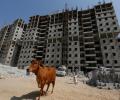
Experts say that the lockdown and its aftermath will further quicken the consolidation in the real estate sector, which has been taking place since 2012, with more small players going out of the business and bigger, branded players dominating the market.

Of the 171 Mumbai scribes tested on April 15, 53 tested positive on April 20. Of the 53 tested positive, 31 were treated and discharged on April 26. A large number of positive cases and later a quick recovery within less than a week have baffled many. Amritha Pillay reports.

RIL's debt stood at Rs 3.06 trillion as of December 2019, against Rs 2.87 trillion in March 2019.

'High-value homes are designed and built on slum lands and slums are given residue. They do not have access to free air and live in close proximity of others.'

Experts say the focus is on preserving liquidity as there is uncertainty over the duration and impact of the 21-day nationwide lockdown imposed to check the spread of COVID-19.
CREDAI-MCHI, a body of developers in Mumbai, has pegged the drop in sales booking at around 80 per cent in the February-March period this year. This is the second highest fall in residential sales in the past five years, after Q1, 2017, when the decline, due to the note ban, was 37 per cent.

According to sources, government officials have asked industry bodies and manufacturers to submit key concerns and requirements to begin manufacturing activity.

The analyst said since servicing of principal and interest on loans will beome challenging for mall operatos in the next couple of months.

Retailers and multiplex operators want mall owners to either forgo rent for the period of the shutdown or lower rent in the event the mall is open but footfalls are low.

Employees asked to work from home... cancelled travel plans... curtailed meetings... Caution and precaution dominate Corporate India's response to Covid-19.

To sell off L&T IDPL, Nabha Power; transfer Hyderabad Metro to an InvIT.

In India, 39 per cent of the sample of a survey said 'very comfortable' for a woman heading the government, higher than 34 per cent who replied with 'very comfortable' for a woman heading a company. However, men are less accepting of such appointments.

Experts feel that mall owners anticipate an increase in costs to the tune of 15-20 per cent annually, prompting a mixed response to the '24 hours' initiative. A mall owner said while the policy is good in spirit, implementing it would be a challenge as night shopping or eating out wasn't a habit in Mumbai yet.
